

Celebrating the Española Healing Foods Oasis’ 10th Anniversary!
This spring we’re celebrating ten years of the Española Healing Foods Oasis! In May 2016, the garden had its first opening day with dozens of residents coming to bless the land and lend their hands and hearts to the work of developing it. During those summer and fall months of 2016, hundreds of volunteers showed up for work days, making possible the lush garden that we enjoy ten years later.
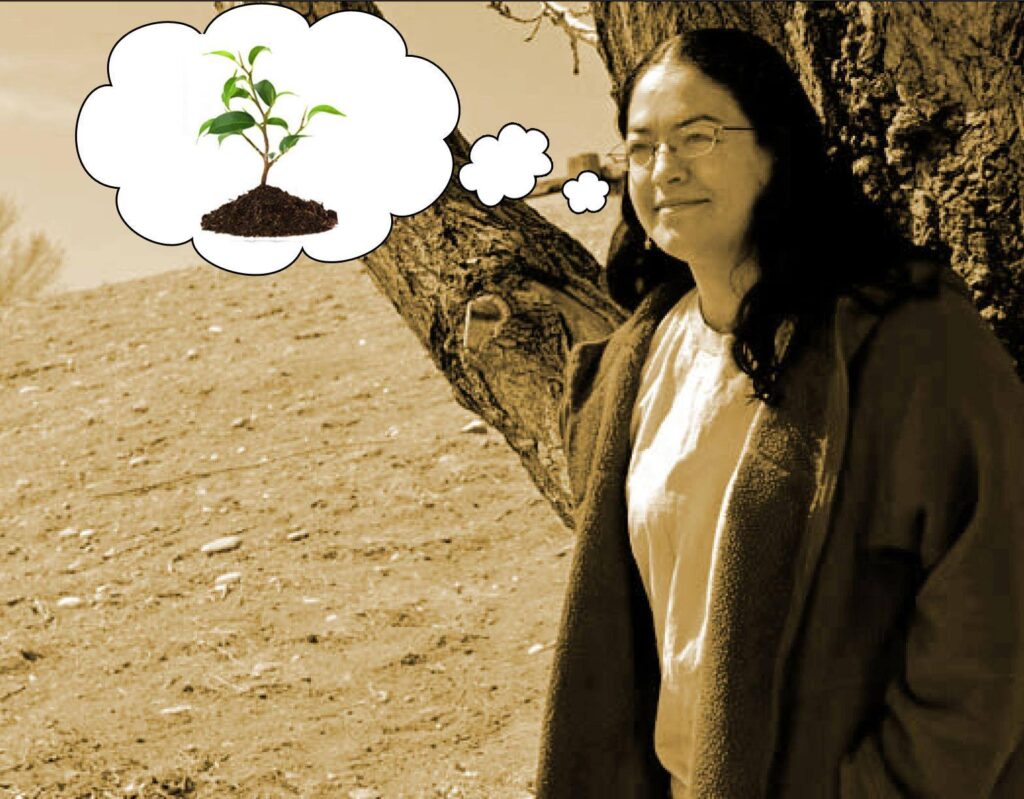
We want to acknowledge the vision and heart work of Beata Tsosie-Peña, who brought the Healing Foods Oasis into being. With her background in Indigenous dry land farming techniques and permaculture, Beata looked at what was then a barren gravel slope leading down from the City Hall parking lot to Valdez Park and knew it could be transformed into an edible food forest and place of gathering and learning. Beata gathered the resources and called in community, and ten years later the EHFO is truly an oasis!
A number of people were instrumental in the visioning and initial phase of the EHFO, including Christie Green, Scott Davis, and the City of Española, who provided the machines and people-power to create the initial terraces of the garden.


With every season and year, the garden took shape. The first year focused on installing a watering system that would work alongside the natural irrigation channels, and growing out each of the swales with native plants and medicinal herbs such as Beebalm, Blue Flax, Yerban del Bue (gumweed), Wild Plum, and Chokecherry. Some of these were planted as “guilds” – plants that thrive when grown together. In 2024, EJ Program Coordinator Kayleigh Warren compiled a beautiful guide to the Plant Relatives of the Healing Foods Oasis.
During the second year, grants and community donations enabled us to build retaining walls and bancos throughout the garden, a key design element that provided seating and aesthetic beauty for visitors. Later years included more fruit tree plantings, installing a layer of detoxifying mycelium, the creation of an Avanyu stone mosaic (look for it near the top terrace), and building a pergola and small amphitheater that created a wonderful space for community events such as workshops and poetry readings.
In 2020, we launched the Española Healing Foods Seed Library, a collaboration between Tewa Women United’s Environmental Health and Justice Program, the New Mexico Acequia Association, Española Public Library, and local Tesuque farmer and activist, Emily Arasim. The Seed Library continues to serve our community from inside the City of Española Public Library.


People noticed the difference —
“The first time I came to Valdez Park, we saw syringes on the ground and it made me sad that this open space/park — one of a very few and so badly needed by this city — was not a place that felt safe or healthy. I’m so happy to be a part of changing that in a positive direction. Thank you for working hard to make this vision a reality, in the most beautiful way possible.”
– Amy Livingston Larsen, Española resident and Healing Foods Oasis volunteer
Over the years, the garden has hosted hundreds of individuals and groups, including the TWU’s Butterfly Wings Summer Program and A’Gin Youth, Strong Families, Northern New Mexico College students, La Tierra Montessori School, Earth Care, Rocky Mountain Youth Corps, Qachuu Aloom/Madre Tierra, The Garden’s Edge, the Northern Youth Project, United World College, and many more.
Participants at the EHFO have learned…
- about dry land water harvesting practices
- how to identify and tie Indian tea (also known as cota, Navajo tea, Tewa tea)
- how to plant, harvest, and prepare amaranth
- how to build a spiral garden with ollas
- about mycelium as a natural filtering mechanism for toxins in the soil
- about the Three Sisters (corn, beans, and squash)
- and much more…


CASE STUDY
In 2025, the University of New Mexico and the Landscape Architecture Foundation did a case study on the Espanola Healing Foods Oasis. Here are just a few of the study’s findings about the garden’s environmental and social impact:
- More than doubles soil microbial biomass carbon and supports a more fungal-dominated microbial community in intensively cultivated garden zones, compared to adjacent degraded soils.
- Improves stormwater infiltration rates over 18 times, from 1.62 in per hour in adjacent untreated slopes to over 10 in per hour in the amended contour swales and terraces, demonstrating the site’s capacity to absorb intense rainfall events and reduce surface runoff.
- Captures up to 90% of runoff volume from the adjacent city hall building and parking lot during a 90th percentile storm event (0.70 in), retaining approximately 3,800 cu ft of rainwater (volume equivalent to 2.8 tanker trucks).
- Increases interest in growing food and Indigenous agriculture practices, with 77% of 22 of surveyed volunteers and visitors expressing motivation to learn more about growing food or medicinal plants and 73% expressing interest in traditional or Indigenous agricultural methods after visiting the garden.
- Enhances emotional well-being, with 67% of 22 surveyed volunteers and visitors reporting a sense of connection to nature, 67% feeling inspired, 67% feeling grounded, and 62% feeling relaxed after visiting
The Española Healing Foods Oasis has not only demonstrated Indigenous sustainable agricultural technologies and climate change adaptability, but continues to build a space for beloved community, interfaith ceremony, healing, and reconnection to our elder plant relatives.
Gratitude for the project’s initial partners:
The City of Española, Four Bridges Traveling Permaculture Institute and the Agri-Kids, ¡Sostenga! Center for Sustainable Food, Agriculture and Environment, American Friends Service Committee AFSC New Mexico, New Mexico Acequia Association, Traditional Native Farmers Association (TNAFA), Honor Our Pueblo Existence, Flowering Tree Permaculture Institute, and Christie Green.
And kuuda to all of you who have come to volunteer and enjoy the garden over the years!